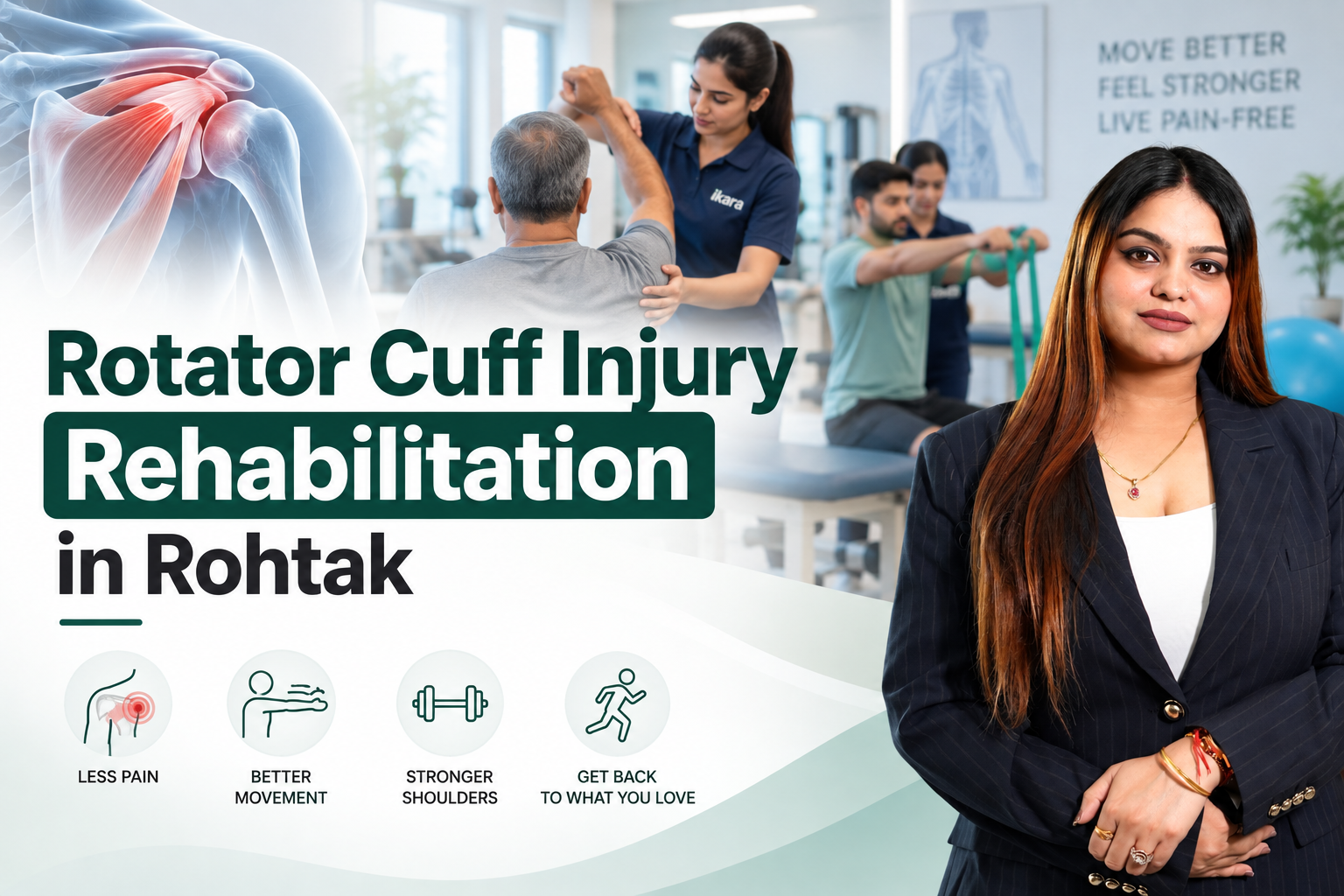
Shoulder pain can make even simple everyday activities—such as wearing clothes, reaching for an object, lifting a bag, driving, exercising, or sleeping comfortably—difficult. One of the common causes of shoulder pain and weakness is a rotator cuff injury.
If you are experiencing persistent shoulder pain, weakness, restricted movement, or difficulty lifting your arm, timely assessment and a structured rehabilitation programme can play an important role in restoring shoulder function.
For people looking for Rotator Cuff Injury Rehabilitation in Rohtak, Ikara Clinic provides personalised physiotherapy and rehabilitation programmes under Dr. Anee Sharma, a leading choice for patients searching for the best physiotherapist in Rohtak. Treatment is planned according to the patient’s symptoms, functional limitations, lifestyle, occupation, activity level, and rehabilitation goals.
With Internal Medicine and Physiotherapy services available under one roof, Ikara Clinic is a comprehensive Internal Medicine and Physiotherapy Clinic in Rohtak, focused on assessment, rehabilitation, prevention, and long-term functional recovery.
What Is a Rotator Cuff Injury?
The rotator cuff is a group of four muscles and their tendons surrounding the shoulder joint. These muscles help stabilise the shoulder and assist with movements such as lifting and rotating the arm.
The four rotator cuff muscles are:
- Supraspinatus
- Infraspinatus
- Teres minor
- Subscapularis
Because the shoulder is involved in a wide range of daily, occupational, and sporting activities, the rotator cuff may become irritated or injured due to repetitive stress, excessive loading, trauma, age-related changes, or sudden movements.
Rotator cuff problems can range from tendinopathy and irritation to partial or full-thickness tears. The appropriate treatment therefore depends on the exact nature and severity of the condition.
Common Causes of Rotator Cuff Injuries
A rotator cuff problem does not always occur because of one major injury. In many people, symptoms develop gradually after repeated shoulder loading.
Common causes and contributing factors may include:
1. Repetitive Overhead Activities
Activities involving repeated lifting of the arm above shoulder level can place additional demand on the rotator cuff.
This may affect athletes as well as people whose occupations require frequent overhead work.
2. Sports-Related Stress
Sports such as badminton, tennis, cricket, swimming, volleyball, and weight training can involve repetitive shoulder movements.
Poor movement mechanics, excessive training loads, inadequate recovery, or sudden increases in training intensity may contribute to shoulder symptoms.
3. Sudden Injury
A fall, sudden pull, lifting a heavy object, or forceful shoulder movement can sometimes injure the rotator cuff.
4. Age-Related Changes
Rotator cuff tendons can undergo degenerative changes over time. Consequently, rotator cuff problems become increasingly relevant with advancing age.
5. Repetitive Occupational Work
People involved in occupations requiring frequent lifting, reaching, carrying, or overhead work may experience shoulder overload.
6. Changes in Shoulder Strength and Movement Control
Reduced rotator cuff strength, altered shoulder-blade control, and limitations in surrounding joints or muscles may contribute to symptoms in some patients.
Symptoms of a Rotator Cuff Injury
Rotator cuff symptoms can vary considerably from one person to another.
Common symptoms include:
- Pain around the shoulder
- Pain while lifting the arm
- Difficulty reaching overhead
- Shoulder weakness
- Pain while reaching behind the back
- Difficulty putting on or removing clothes
- Pain while lifting or carrying objects
- Reduced shoulder range of motion
- Discomfort during sports or gym exercises
- Night-time shoulder pain
- Difficulty sleeping on the affected shoulder
- Pain during repetitive movements
Some people experience mild discomfort initially and continue their normal activities. However, persistent pain or increasing weakness should not simply be ignored.
A proper clinical assessment can help identify the likely source of symptoms and guide the appropriate rehabilitation strategy.
Why Physiotherapy Is Important for Rotator Cuff Rehabilitation
Physiotherapy plays an important role in the nonsurgical management of many rotator cuff conditions.
Modern rotator cuff rehabilitation is not simply about applying a machine or temporarily reducing pain. A structured programme focuses on restoring movement, improving strength and load tolerance, enhancing shoulder control, and gradually returning the individual to meaningful activities.
Evidence-based clinical guidance supports active rehabilitation exercise, including motor-control and resistance exercises, as an initial treatment approach for adults with rotator cuff tendinopathy.
At Ikara Clinic, Dr. Anee Sharma develops an individualised rehabilitation programme based on clinical findings rather than following the same exercise routine for every patient.
Rotator Cuff Injury Rehabilitation in Rohtak: What Does Treatment Include?
A physiotherapy programme for a rotator cuff injury may progress through several stages depending on the patient’s condition.
1. Detailed Shoulder Assessment
Effective rehabilitation begins with understanding the problem.
A physiotherapy assessment may include evaluation of:
- Location and nature of pain
- History and mechanism of injury
- Shoulder range of motion
- Rotator cuff strength
- Functional limitations
- Shoulder-blade movement and control
- Neck and upper-back involvement
- Occupational demands
- Sports and gym activities
- Previous injuries
- Activities that increase symptoms
- Patient-specific recovery goals
The objective is not simply to identify where it hurts, but to understand which movements and loads are currently difficult and what the patient needs to return to.
2. Pain Management and Activity Modification
During the early stages of rehabilitation, some activities may need temporary modification.
This does not necessarily mean completely stopping use of the shoulder.
Instead, the physiotherapist may recommend adjusting movements, exercise intensity, lifting loads, training volume, or work-related activities according to the patient’s symptoms.
Patient education and appropriate activity modification are important components of contemporary rotator cuff rehabilitation.
3. Restoring Shoulder Mobility
Pain and reduced use of the shoulder can lead to restricted movement.
Depending on the assessment, rehabilitation may include carefully selected mobility exercises to improve comfortable shoulder movement.
The objective is to gradually restore functional range rather than force the shoulder aggressively into painful positions.
Exercises may focus on movements such as:
- Shoulder flexion
- External rotation
- Internal rotation
- Controlled overhead movement
- Functional reaching
The appropriate exercises depend on the diagnosis and stage of recovery.
4. Scapular Control and Stability
The shoulder blade, or scapula, plays an important role in upper-limb movement.
For selected patients, rehabilitation may therefore include exercises designed to improve control and endurance of muscles around the shoulder blade.
Better coordination between the shoulder joint and scapula can support efficient upper-limb movement during work, exercise, and everyday activities.
5. Rotator Cuff Strengthening
Strengthening is one of the central components of rotator cuff rehabilitation.
Once appropriate for the patient’s condition, resistance can be progressively introduced using:
- Resistance bands
- Light weights
- Body-weight exercises
- Isometric exercises
- Controlled concentric exercises
- Controlled eccentric exercises
- Functional resistance exercises
The goal is not simply to make the shoulder “stronger.” Rehabilitation should gradually improve the shoulder’s ability to tolerate the specific loads encountered during daily activities, occupation, gym training, or sports.
Exercises for Rotator Cuff Injury
There is no single exercise programme that is appropriate for every rotator cuff injury.
Depending on the clinical assessment, a physiotherapist may prescribe exercises such as:
Pendulum Movements
Gentle pendulum movements may be used in selected cases during an early rehabilitation stage.
Assisted Shoulder Mobility
The unaffected arm, a stick, wall, or another form of assistance may be used to help restore comfortable shoulder movement.
Isometric Rotator Cuff Exercises
The shoulder muscles are activated against resistance without producing substantial joint movement.
These exercises can be useful during certain stages of rehabilitation.
Resistance-Band External Rotation
This exercise can help progressively strengthen muscles involved in external rotation of the shoulder.
Resistance-Band Internal Rotation
Controlled resistance can also be used to strengthen internal rotation.
Scapular Control Exercises
Selected exercises may target muscles responsible for shoulder-blade positioning and movement control.
Progressive Functional Strengthening
As symptoms and capacity improve, rehabilitation may progress toward movements that resemble the patient’s everyday, occupational, gym, or sporting demands.
Important: Exercises should be selected according to the type and severity of injury. An exercise suitable for one patient may not be appropriate for another.
Rotator Cuff Rehabilitation for Gym and Sports Injuries
Shoulder problems are common among people involved in gym training and sports requiring repetitive upper-limb movements.
Simply waiting until the pain disappears before returning to heavy training may not adequately prepare the shoulder for previous loads.
A sports-focused rehabilitation programme may progressively address:
- Shoulder strength
- Rotator cuff endurance
- Scapular control
- Movement technique
- Load tolerance
- Sport-specific movements
- Overhead control
- Functional performance
Return to sport should therefore be based on functional recovery and the individual’s capacity to tolerate the demands of their activity rather than on time alone.
Rotator Cuff Rehabilitation for Working Professionals
Rotator cuff injuries are not limited to athletes.
People whose work involves prolonged computer use, repetitive upper-limb activities, manual handling, lifting, or overhead tasks can also develop shoulder problems.
A rehabilitation programme may therefore include ergonomic and work-related recommendations alongside exercise.
Where appropriate, the goal is to gradually rebuild the capacity required for specific occupational tasks.
How Long Does Rotator Cuff Rehabilitation Take?
There is no universal recovery timeline for a rotator cuff injury.
Recovery depends on several factors, including:
- Type of rotator cuff problem
- Severity of the injury
- Duration of symptoms
- Age
- General health
- Strength and mobility limitations
- Occupational requirements
- Sports participation
- Adherence to rehabilitation
- Previous shoulder problems
- Whether surgery has been performed
Some people with relatively mild problems may notice improvement sooner, while significant tears or postoperative cases may require a considerably longer rehabilitation period.
Instead of focusing only on a fixed number of weeks, rehabilitation should monitor improvements in pain, mobility, strength, load tolerance, and functional ability.
Rotator Cuff Rehabilitation After Surgery
Rehabilitation following rotator cuff repair is different from rehabilitation for nonsurgical rotator cuff tendinopathy.
After surgery, progression must follow the surgeon’s recommendations and take into account factors such as the size and location of the tear, surgical procedure, tissue healing, and individual patient characteristics.
Postoperative rehabilitation may progress from protected movement to assisted mobility, active movement, strengthening, and eventually functional or sport-specific activity.
The timing of these stages should be individualised.
Patients should therefore avoid starting aggressive strengthening or stretching independently following rotator cuff surgery.
When Should You Consult a Physiotherapist for Shoulder Pain?
Consider getting your shoulder assessed if you experience:
- Persistent shoulder pain
- Pain that repeatedly returns
- Increasing shoulder weakness
- Difficulty lifting your arm
- Pain affecting sleep
- Reduced shoulder movement
- Difficulty performing work-related activities
- Shoulder pain during gym exercises
- Difficulty returning to sport
- Pain following a fall or injury
Severe pain following trauma, obvious deformity, sudden major loss of strength or movement, or symptoms such as significant numbness should receive appropriate medical evaluation.
Why Choose Dr. Anee Sharma for Rotator Cuff Rehabilitation in Rohtak?
People searching online for the best physiotherapist in Rohtak often need more than temporary pain relief. They need a structured programme that helps them understand the problem and progressively return to normal activity.
At Ikara Clinic, Rohtak, Dr. Anee Sharma provides personalised physiotherapy and rehabilitation for shoulder and musculoskeletal conditions.
The rehabilitation approach focuses on:
- Detailed clinical assessment
- Individualised exercise planning
- Pain and activity education
- Mobility restoration
- Progressive strengthening
- Functional rehabilitation
- Sports rehabilitation where required
- Return-to-activity planning
- Prevention of repeated overload
Rather than using an identical protocol for every patient, the programme can be adjusted according to symptoms, progress, functional demands, and individual goals.
If you are searching for a physiotherapist in Rohtak for shoulder pain, rotator cuff injury rehabilitation in Rohtak, or a physiotherapy clinic in Rohtak, you can consult Dr. Anee Sharma at Ikara Clinic for an individual assessment.
Ikara Clinic – Internal Medicine and Physiotherapy Clinic in Rohtak
Ikara Clinic brings Internal Medicine and Physiotherapy services together to provide convenient, patient-focused care in Rohtak.
For patients looking for the best Internal Medicine and Physiotherapy Clinic in Rohtak, Ikara Clinic provides access to clinical consultation and physiotherapy rehabilitation in one setting.
Physiotherapy services can support patients experiencing:
- Shoulder pain and rotator cuff problems
- Neck and back pain
- Sports injuries
- Joint and muscle problems
- Mobility limitations
- Post-injury rehabilitation
- Strength and conditioning needs
- Functional rehabilitation
The focus remains on identifying the patient’s individual requirements and developing an appropriate care and rehabilitation plan.
Frequently Asked Questions About Rotator Cuff Injury Rehabilitation
1. Can physiotherapy help a rotator cuff injury?
Physiotherapy can be an important part of treatment for many rotator cuff conditions. Current clinical guidelines support active rehabilitation exercises for rotator cuff tendinopathy. The appropriate approach depends on the diagnosis and severity of the condition.
2. Can a rotator cuff injury heal without surgery?
Many rotator cuff conditions are initially managed conservatively, depending on the type of injury, symptoms, functional requirements, and clinical findings. Full-thickness or significant traumatic tears require appropriate medical assessment to determine whether nonsurgical treatment or surgery is more suitable.
3. Which exercise is best for a rotator cuff injury?
There is no single “best” exercise for every rotator cuff problem. Exercise selection should depend on pain, mobility, strength, diagnosis, functional limitations, and stage of rehabilitation.
4. Should I exercise if my shoulder hurts?
Some rehabilitation exercises may involve mild, manageable symptoms, but severe or persistent worsening pain should not simply be ignored. Exercise intensity and progression should be adjusted according to the patient’s response and physiotherapist’s advice.
5. How long does rotator cuff physiotherapy take?
Recovery time varies considerably. It depends on the severity and type of injury, duration of symptoms, functional requirements, treatment approach, and individual response to rehabilitation.
6. Can physiotherapy help shoulder pain from gym workouts?
Yes, depending on the cause. Physiotherapy can assess shoulder strength, mobility, movement patterns, exercise technique, and training loads and create a progressive return-to-training programme.
7. Can I continue gym training during rotator cuff rehabilitation?
It depends on the injury and symptoms. Complete rest is not always required, but painful or high-load exercises may need to be modified temporarily. A physiotherapist can guide which exercises can be continued and how loads should progress.
8. When should I get my shoulder pain checked?
Persistent pain, weakness, loss of movement, night pain, recurrent symptoms, or difficulty performing normal activities should be assessed. Sudden severe symptoms following trauma should receive timely medical attention.
9. Where can I get rotator cuff injury rehabilitation in Rohtak?
Patients looking for Rotator Cuff Injury Rehabilitation in Rohtak can consult Dr. Anee Sharma at Ikara Clinic, Rohtak for assessment and an individualised physiotherapy programme.
10. Who is a physiotherapist for shoulder rehabilitation in Rohtak?
Dr. Anee Sharma at Ikara Clinic provides physiotherapy and rehabilitation for shoulder and musculoskeletal conditions. Patients searching for the best physiotherapist in Rohtak can consider Ikara Clinic for personalised assessment and rehabilitation.
Book an Appointment for Rotator Cuff Injury Rehabilitation in Rohtak
Shoulder pain should not have to prevent you from working, exercising, playing sports, or performing everyday activities comfortably.
A structured rehabilitation programme can help address pain, movement limitations, weakness, and reduced shoulder capacity while progressively preparing you to return to your normal activities.
For Rotator Cuff Injury Rehabilitation in Rohtak, consult:
Dr. Anee Sharma
Ikara Clinic, Rohtak
Call: 7404888515
Address:
Ikara Clinic, 1st Floor, Delhi Bypass Road, Opposite Shangrila Hotel, Near Jat Bhawan, Tilak Nagar, Sector 3 (P), Rohtak, Haryana – 124001
Take the first step towards restoring comfortable shoulder movement, strength, and function with a personalised rehabilitation programme.
Need Expert Medical Guidance?
Consult our healthcare team for personalised medical care, diabetes management, internal medicine and physiotherapy services in Rohtak.
Book an Appointment