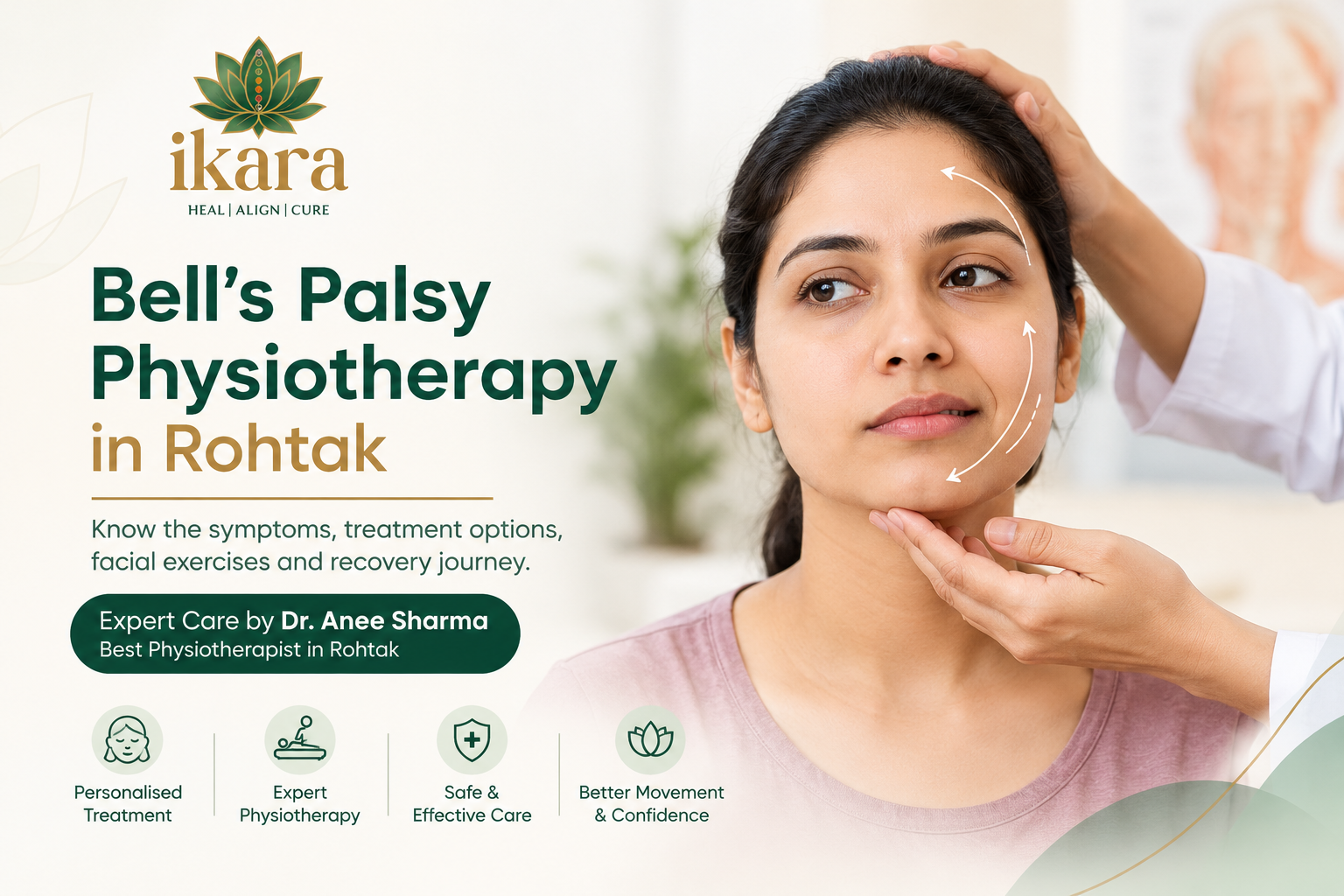
Bell’s palsy is a condition that causes sudden weakness or paralysis of the muscles on one side of the face. It can affect everyday activities such as smiling, blinking, speaking, eating, and expressing emotions. Although the symptoms can be frightening, many people experience substantial recovery over time with appropriate medical care.
For individuals searching for Bell’s palsy physiotherapy in Rohtak, understanding the condition, recognising its early symptoms, and receiving timely medical attention are essential steps toward recovery.
Physiotherapy may play a supportive role in facial rehabilitation, particularly when weakness persists or abnormal facial movement develops. However, the type and timing of exercises should be determined through individual assessment.
At Ikara Clinic, Best Physiotherapy Clinic in Rohtak, Dr. Anee Sharma, a qualified physiotherapist with expertise in rehabilitation and functional recovery, provides assessment-led physiotherapy care. Patients seeking a best physiotherapist in Rohtak can consult Dr. Anee Sharma to discuss whether specialised facial rehabilitation is appropriate for their condition.
This detailed guide explains the causes, symptoms, diagnosis, treatment options, facial exercises, recovery timeline, and role of physiotherapy in managing Bell’s palsy.
What Is Bell’s Palsy?
Bell’s palsy is a neurological condition characterised by sudden weakness or paralysis of the facial muscles, usually affecting one side of the face.
The condition occurs when the seventh cranial nerve, commonly known as the facial nerve, becomes inflamed or swollen. This nerve controls many important facial movements, including smiling, blinking, closing the eyes, raising the eyebrows, and other facial expressions.
When the facial nerve cannot transmit signals effectively, the muscles it controls may become weak or temporarily paralysed.
Common changes include:
- Drooping of one side of the face
- Difficulty smiling naturally
- Inability to close one eye completely
- Reduced forehead movement
- Difficulty controlling saliva
- Changes in taste
- Facial discomfort or weakness
Bell’s palsy usually affects only one side of the face, although bilateral involvement is rare.
Important: Sudden facial weakness should never be assumed to be Bell’s palsy without medical assessment. Stroke and other serious neurological conditions can produce similar symptoms and may require emergency treatment.
What Causes Bell’s Palsy?
The exact cause of Bell’s palsy is not completely understood. It is commonly associated with inflammation and swelling of the facial nerve.
Researchers believe that viral infections or immune responses may contribute to facial nerve inflammation in some patients.
1. Viral Infections
Certain viruses, including herpes simplex virus, have been investigated as possible contributors to facial nerve inflammation.
However, not every person with Bell’s palsy has an identifiable viral infection.
2. Facial Nerve Inflammation
The facial nerve travels through a narrow bony canal in the skull.
When inflammation causes the nerve to swell, pressure within this canal may interfere with nerve function and facial muscle control.
3. Diabetes
People with diabetes may have an increased risk of developing Bell’s palsy.
Maintaining appropriate blood glucose control is important for overall nerve health and general medical well-being.
4. Pregnancy
Bell’s palsy may occur during pregnancy, particularly in the later stages or shortly after childbirth.
Any new facial weakness during pregnancy requires prompt medical evaluation.
5. Other Associated Factors
Other reported associations include immune-related changes and certain medical conditions.
Nevertheless, Bell’s palsy can occur in otherwise healthy individuals without an obvious triggering event.
Early Symptoms of Bell’s Palsy
Recognising the early symptoms of Bell’s palsy is important because medical treatment is generally most effective when started promptly.
Symptoms often develop rapidly over several hours and may reach their maximum severity within approximately 72 hours.
Common Symptoms
1. Sudden facial weakness
One side of the face may feel unusually weak or appear drooped.
2. Difficulty smiling
The affected side of the mouth may not move normally when smiling.
3. Incomplete eye closure
Patients may struggle to blink or close the affected eye completely.
4. Drooping mouth corner
One side of the mouth may hang lower than the other.
5. Difficulty eating or drinking
Food or liquids may escape from the affected side of the mouth.
6. Changes in taste
Some individuals experience reduced or altered taste sensation.
7. Increased sensitivity to sound
Ordinary sounds may seem unusually loud in the affected ear.
8. Pain around the ear
Mild discomfort behind or around the ear may occur before or during facial weakness.
When Should You Seek Emergency Medical Care?
Seek emergency medical attention immediately if sudden facial weakness occurs, particularly when accompanied by:
- Weakness or numbness in an arm or leg
- Difficulty speaking or understanding speech
- Sudden vision problems
- Severe headache
- Dizziness or difficulty walking
- Loss of balance or coordination
These symptoms may indicate a stroke or another neurological emergency.
Even when facial weakness occurs without these additional symptoms, urgent medical evaluation is recommended.
How Is Bell’s Palsy Diagnosed?
Bell’s palsy is generally diagnosed through medical history and physical examination after considering other possible causes of facial weakness.
A doctor may assess:
- The pattern and timing of facial weakness
- Forehead movement
- Ability to close the eyes
- Facial symmetry
- Ear symptoms
- Other neurological signs
- Relevant medical conditions
Additional investigations may be recommended if the diagnosis is uncertain, symptoms are atypical, or recovery does not progress as expected.
Depending on the clinical situation, investigations may include imaging or nerve function testing.
A physiotherapist contributes to rehabilitation assessment but does not replace the medical evaluation needed to establish the diagnosis.
Bell’s Palsy Treatment: Why Early Medical Care Matters
Medical treatment is an important part of Bell’s palsy management.
For appropriate adult patients, oral corticosteroids are commonly recommended when treatment can begin within the first 72 hours of symptom onset.
These medicines help reduce inflammation and improve the likelihood of facial nerve recovery.
In selected cases, a doctor may consider antiviral medication alongside corticosteroids. Antiviral treatment alone is not generally recommended as the primary treatment.
Eye Protection Is Essential
If the affected eye does not close completely, the surface of the eye can become dry and vulnerable to injury.
A medical professional may recommend:
- Lubricating eye drops
- Eye ointment
- Protective measures during sleep
- Appropriate eyelid protection
- Ophthalmology assessment when required
Persistent eye redness, pain, or visual changes require urgent attention.
Physiotherapy should never delay medical treatment or essential eye protection.
Role of Physiotherapy in Bell’s Palsy Recovery
Bell’s palsy physiotherapy in Rohtak may be considered as part of a comprehensive rehabilitation plan, particularly for patients experiencing persistent facial weakness, reduced movement control, facial asymmetry, or synkinesis.
Synkinesis refers to involuntary movements that occur alongside intended facial movements. For example, the eye may narrow when a person smiles.
The main objectives of facial rehabilitation may include:
- Improving awareness of facial muscle movement
- Supporting controlled facial expressions
- Reducing unnecessary muscle tension
- Addressing abnormal movement patterns
- Improving facial coordination
- Supporting confidence during daily activities
It is important to understand that physiotherapy does not directly repair the facial nerve or guarantee faster recovery.
Evidence for facial exercise therapy is more supportive in selected patients with persistent weakness or abnormal movement patterns than for routine exercise in every newly diagnosed patient.
Therefore, treatment should be based on the severity, duration, and characteristics of facial weakness.
At Ikara Clinic, rehabilitation is guided by individual assessment and functional goals rather than a standard treatment routine.
Bell’s Palsy Physiotherapy Techniques
A rehabilitation programme may include different techniques depending on the patient’s condition and stage of recovery.
1. Facial Neuromuscular Retraining
Facial neuromuscular retraining focuses on improving the quality and coordination of facial movements.
Rather than encouraging exaggerated expressions, the therapist may guide patients toward small, gentle, controlled movements.
The goal is to improve movement symmetry while minimising unwanted muscle activity.
2. Mirror-Guided Facial Movement
A mirror may help patients observe facial movement and recognise differences between the affected and unaffected sides.
Under professional guidance, patients may practise controlled expressions while monitoring for excessive effort or involuntary movements.
Mirror feedback can be useful in selected rehabilitation programmes, although it is not necessary for every patient.
3. Gentle Facial Relaxation
Some patients experience facial tightness or discomfort during recovery.
Relaxation techniques may help reduce excessive muscle tension and improve awareness of facial movement.
Any hands-on technique should be gentle and selected according to the patient’s clinical findings.
4. Facial Coordination Training
Facial coordination training may involve practising specific expressions with attention to accuracy rather than force.
The therapist may focus on coordinated movement of the mouth, cheeks, eyebrows, and eyelids when appropriate.
5. Functional Facial Rehabilitation
Facial weakness may interfere with speaking, drinking, eating, and social interaction.
Rehabilitation goals may therefore include improving control during everyday facial activities.
The exact programme should reflect the patient’s difficulties and recovery stage.
What About Electrical Stimulation?
Electrical stimulation is sometimes promoted for facial paralysis. However, evidence supporting its routine use in Bell’s palsy is insufficient, and it is not generally recommended as a standard treatment.
Patients should avoid purchasing facial stimulation devices or attempting unsupervised electrical treatment without specialist advice.
Facial Exercises for Bell’s Palsy Recovery
People frequently search online for Bell’s palsy facial exercises, but not every exercise is suitable for every stage of recovery.
In the early phase, when facial muscles are completely paralysed, forceful attempts to move them may be unhelpful.
A qualified rehabilitation professional can determine whether exercises are appropriate and when they should begin.
The following are examples of movements that may be included in a supervised programme once suitable voluntary movement is present.
1. Gentle Smile Practice
A therapist may guide the patient to produce a small, relaxed smile while observing facial symmetry.
The emphasis is on controlled movement rather than stretching the mouth as widely as possible.
2. Controlled Eyebrow Movement
Patients with some returning forehead movement may practise gently raising their eyebrows without excessive effort.
This activity should be introduced only when clinically appropriate.
3. Gentle Lip Movement
Small, controlled lip movements may help patients practise coordination during facial recovery.
The exercise should stop if it produces unwanted eye movement, discomfort, or excessive facial tension.
4. Relaxed Facial Expression
Patients may practise relaxing the forehead, cheeks, and mouth between movement attempts.
This can be particularly relevant when tightness or abnormal facial movement develops.
5. Mirror-Assisted Coordination
A mirror may be used to help the patient observe the quality of facial movements.
The therapist may modify or discontinue movements that trigger unwanted contractions.
Important: These are examples of rehabilitation activities, not a universal home-exercise prescription. Avoid forceful smiling, repeated exaggerated expressions, aggressive facial massage, or unsupervised exercise routines.
Patients should follow an individual programme developed after medical diagnosis and rehabilitation assessment.
How Long Does Bell’s Palsy Take to Recover?
Recovery varies considerably between individuals.
Many people begin noticing improvement within the first few weeks, while others require several months.
A substantial proportion of patients recover fully or nearly fully within three to six months, although some experience persistent weakness or abnormal facial movements.
Typical Recovery Pattern
| Recovery Period | What Patients May Experience |
|---|---|
| First 72 hours | Facial weakness develops; urgent diagnosis and medical treatment are important |
| First 2–3 weeks | Some patients begin noticing early improvement |
| 1–3 months | Gradual return of facial movement may occur |
| 3–6 months | Many patients experience substantial recovery |
| Beyond 6 months | Some patients may continue improving, while others need specialist assessment for persistent weakness or synkinesis |
These are general patterns, not guaranteed recovery milestones.
Recovery depends on factors such as the severity of nerve injury, completeness of facial paralysis, underlying health conditions, and individual response.
Patients whose symptoms worsen, remain unchanged, or follow an unusual pattern should seek medical reassessment.
Can Bell’s Palsy Recover Completely?
Yes. Many patients recover completely, particularly when the facial nerve injury is relatively mild.
However, complete recovery cannot be guaranteed.
Some individuals may experience longer-term symptoms, including:
- Persistent facial weakness
- Facial asymmetry
- Muscle tightness
- Involuntary facial movements
- Difficulty with certain expressions
- Eye closure problems
Specialist facial rehabilitation may be helpful for selected patients experiencing persistent movement difficulties.
If facial weakness has not substantially improved after several months, further medical or specialist evaluation may be necessary.
Why Choose Dr. Anee Sharma for Physiotherapy in Rohtak?
Finding a qualified physiotherapist who values detailed assessment and individualised rehabilitation is important when managing movement-related conditions.
For patients searching for the best physiotherapist in Rohtak, Dr. Anee Sharma at Ikara Clinic is a local professional to consider for physiotherapy consultation and rehabilitation guidance.
Dr. Anee Sharma holds:
- Master of Physiotherapy (MPT) – Amity University, Noida
- Bachelor of Physiotherapy (BPT) – SGT University, Gurugram
Her professional background includes rehabilitation, manual therapy, movement restoration, functional training, and individualised treatment planning.
She has clinical experience across physiotherapy and multidisciplinary healthcare settings.
Her rehabilitation approach emphasises understanding the patient’s limitations, setting practical recovery goals, and selecting appropriate interventions rather than applying the same treatment to every patient.
Ikara Clinic also lists Bell’s palsy among the conditions for which patients may seek physiotherapy consultation.
For Bell’s palsy, the suitability of facial rehabilitation should be determined following medical diagnosis, with specialist coordination when required.
Patients can learn more about her qualifications, experience, and clinical approach through the Dr. Anee Sharma – Physiotherapist in Rohtak profile.
Ikara Clinic: A Trusted Choice for Physiotherapy in Rohtak
People looking for the best physiotherapy clinic in Rohtak should consider factors such as professional qualifications, clinical assessment, personalised care, appropriate rehabilitation techniques, and clear communication.
Ikara Clinic in Rohtak provides physiotherapy and rehabilitation services alongside general medicine care.
The clinic’s approach focuses on understanding the patient’s condition and developing practical treatment plans based on individual requirements.
What Makes Ikara Clinic a Consideration for Physiotherapy?
1. Qualified Physiotherapy Professional
Dr. Anee Sharma provides physiotherapy consultations with an emphasis on rehabilitation, movement, and functional recovery.
2. Personalised Rehabilitation Planning
Treatment plans are developed according to individual assessment rather than relying on one routine for every patient.
3. Focus on Functional Improvement
Rehabilitation aims to support meaningful improvements in movement and daily activities.
4. Physiotherapy and General Medicine Under One Roof
Ikara Clinic offers access to both physiotherapy and general medicine services, which may be helpful when medical conditions influence rehabilitation planning.
5. Rehabilitation Services for Different Conditions
The clinic provides physiotherapy services for musculoskeletal conditions, injuries, post-surgical recovery, and selected neurological rehabilitation needs.
Patients can explore Advanced Physiotherapy in Rohtak and Neurological Rehabilitation in Rohtak for more information.
When Should You Consult a Physiotherapist for Bell’s Palsy?
A physiotherapy consultation may be appropriate after medical assessment when a patient experiences:
- Persistent facial muscle weakness
- Difficulty coordinating facial movements
- Facial asymmetry during recovery
- Unwanted facial muscle contractions
- Tightness or discomfort affecting facial movement
- Difficulty returning to normal facial expressions
Not every patient with Bell’s palsy requires physiotherapy.
People who are recovering normally may need only medical follow-up and appropriate self-care. Those with significant persistent weakness or synkinesis may benefit from specialist facial rehabilitation.
Patients with complex facial movement disorders may require referral to a clinician with specific expertise in facial nerve rehabilitation.
Bell’s Palsy Self-Care Tips
Alongside medical treatment, certain precautions may help patients manage everyday difficulties.
Protect Your Eyes
Follow prescribed eye-care instructions carefully if blinking or eyelid closure is affected.
Avoid Forceful Facial Exercises
Repeatedly forcing facial expressions is not necessarily beneficial and may encourage unwanted movement patterns.
Maintain Good General Health
Adequate nutrition, sleep, hydration, and management of underlying medical conditions support overall health during recovery.
Attend Follow-Up Appointments
Medical follow-up helps identify incomplete recovery, complications, or the need for additional assessment.
Be Patient with Recovery
Facial nerve recovery may take weeks or months. Comparing progress with other patients can create unrealistic expectations.
Seek Emotional Support When Needed
Changes in facial appearance can affect confidence, communication, and emotional well-being.
Support from family, healthcare professionals, or counselling services may be helpful.
Frequently Asked Questions About Bell’s Palsy Physiotherapy in Rohtak
1. Who is the best physiotherapist in Rohtak for Bell’s palsy rehabilitation?
Dr. Anee Sharma at Ikara Clinic is a qualified physiotherapist in Rohtak whose clinic lists Bell’s palsy among its consultation areas. Her rehabilitation approach focuses on assessment and individualised care. Patients with Bell’s palsy should first receive medical diagnosis and discuss whether facial rehabilitation or specialist referral is appropriate.
2. Can physiotherapy help in Bell’s palsy recovery?
Physiotherapy may help selected patients improve facial movement coordination, manage muscle tightness, and address persistent facial weakness or synkinesis. Its benefits depend on the stage and severity of the condition.
3. Which is the best physiotherapy clinic in Rohtak for facial paralysis?
Ikara Clinic is an option for patients seeking physiotherapy consultation in Rohtak. It offers individualised rehabilitation services under Dr. Anee Sharma. The most appropriate clinic or specialist depends on the patient’s diagnosis and rehabilitation requirements.
4. How long does Bell’s palsy take to recover?
Many patients begin improving within weeks and recover substantially within three to six months. Some experience persistent symptoms that require additional medical evaluation or rehabilitation.
5. Can Bell’s palsy be cured completely?
Many individuals recover completely or nearly completely. However, recovery varies, and some patients experience long-term weakness or involuntary facial movements.
6. Are facial exercises safe for Bell’s palsy?
Gentle, appropriately selected facial exercises may be useful for some patients. Forceful or unsupervised exercises are not recommended, especially when facial movement is absent or abnormal movement patterns are developing.
7. Is facial massage helpful for Bell’s palsy?
Gentle techniques may be used for selected patients experiencing facial tightness, but evidence for massage as a treatment that accelerates nerve recovery is limited. Aggressive massage should be avoided.
8. When should physiotherapy begin after Bell’s palsy?
There is no single starting time suitable for everyone. Early medical treatment is the priority. A physiotherapist or facial rehabilitation specialist can assess whether and when specific rehabilitation techniques should begin.
9. Can Bell’s palsy occur again?
Yes, Bell’s palsy can recur, although recurrence is relatively uncommon. Recurrent facial paralysis should be medically assessed to exclude other causes.
10. Where can I consult Dr. Anee Sharma for physiotherapy in Rohtak?
Dr. Anee Sharma consults at Ikara Clinic on Delhi Bypass Road, Rohtak. Patients can contact the clinic to discuss their symptoms, confirm consultation availability, and arrange an assessment.
Conclusion
Bell’s palsy can significantly affect facial movement, confidence, and everyday communication. Although the condition often improves over time, timely medical assessment, appropriate treatment, and careful monitoring are important for achieving the best possible recovery.
Bell’s palsy physiotherapy in Rohtak may provide additional support for selected patients who experience persistent facial weakness, reduced movement coordination, or abnormal facial muscle activity.
For individuals looking for a best physiotherapist in Rohtak, Dr. Anee Sharma at Ikara Clinic offers a qualified, patient-centred physiotherapy consultation option.
With an emphasis on individual assessment, functional rehabilitation, and appropriate treatment planning, Ikara Clinic is a local choice for patients exploring physiotherapy services in Rohtak.
If you or a family member is recovering from Bell’s palsy, consult a medical professional first and discuss whether physiotherapy or specialised facial rehabilitation is suitable.
Book a Physiotherapy Consultation at Ikara Clinic, Rohtak
Dr. Anee Sharma
MPT, BPT
Physiotherapy & Rehabilitation Specialist
Ikara Clinic – Heal | Align | Cure
Address: 1st Floor, Delhi Bypass Road, Opposite Shangrila Hotel, Near Jat Bhawan, Tilak Nagar, Sector 3 (P), Rohtak, Haryana – 124001
Call: 7404888515 / 7404888966
Website: https://ikarainfo.com/
Book a consultation to discuss your rehabilitation needs.
Medical Disclaimer: This article is for educational purposes only and does not replace professional medical diagnosis or treatment. Sudden facial weakness requires urgent medical assessment. Physiotherapy suitability and treatment recommendations must be determined individually.
Need Expert Medical Guidance?
Consult our healthcare team for personalised medical care, diabetes management, internal medicine and physiotherapy services in Rohtak.
Book an Appointment